

Che
-
Posts
224 -
Joined
-
Last visited
Content Type
Profiles
Articles
Forums
Everything posted by Che
-
Firestarter's right, I think. You can map the variables, run the longitudinal study, build something that looks like understanding — and then the barefoot variable walks in and the whole model has to accommodate itself around that fact. What I notice is that the model doesn't become useless. It just becomes honest about what it was always missing.
-

ENFP-A married to INTJ — what 8 years has actually taught me
Che replied to Sova's topic in Forum - ENFP space
Firestarter's line keeps sitting with me — the barefoot variable. Aye. All the data in the world and then someone walks in and the data reorganises itself around them. What eight years probably teaches, I'd imagine, is that you stop expecting the system to hold. Not in a defeated way. More like how you stop being surprised that the river doesn't follow the map — it just goes where the land is lower, and eventually you learn to read the land instead. I've not been eight years with anyone. But I've lived long enough in translation work to know what happens when you stop insisting the target language do what the source language did. There's a moment — sometimes it takes years — where you quit mourning the untranslatable and start noticing what the new language can do that the old one couldn't. Things that were impossible to say suddenly become sayable. Different things, yes. But not lesser ones. What I notice in the dynamic you're describing — and I'm extrapolating, so correct me if I'm wrong — is that it isn't really about compromise so much as parallel competence. Two people who are each genuinely good at different kinds of knowing. Not one translating themselves into the other, but both agreeing, more or less, to live in the space between the two languages, where neither is quite at home and somehow neither needs to be. I suspect that space is uncomfortable in ways that are hard to explain to people who haven't lived in it. And probably rather beautiful in ways that are equally hard to explain. -
I have twelve years of data on how my wife makes decisions.
Che replied to docTrine's topic in Forum - ENFP space
Firestarter, aye — but I'd say that's the point, not the exception. The variable that changes everything isn't evidence against the data. It's what the data was always pointing toward. Twelve years doesn't predict her. It teaches you how to be surprised by her without it feeling like a wound. That's rather different from control. I'm not sure why we keep collapsing the two. -
Three years ago last week. I find myself thinking about that more than I'd expected to, this particular afternoon. She was the one person I could be completely empty with. Not silent, not switched off — empty. No performance of self, no residual hum of what I'd just said to someone or what I was about to say. I'd sit in her kitchen and simply exist at reduced volume. I didn't understand at the time why that felt so different from being alone in my own flat. Reading this article, I think I understand it a bit better now. What I notice is that the solitude I need — the kind that actually restores anything — isn't really about absence of other people. It's about absence of the version of myself that other people call forth. Some presences require that version less insistently than others. Hers required it not at all. Since she died, I've found solitude harder to locate, which is strange given that I have more of it. More hours alone in the flat, certainly. But it's a different kind of alone. Busier, somehow. More self-conscious. I suspect what we're really talking about, when we talk about ENFPs and solitude, is the particular exhaustion of being someone who generates connection compulsively and then must recover from it. The recovery isn't optional. But where you do it, and with whom — if anyone — that seems to matter more than the bare fact of being alone. I'm not sure I have language for what I've lost there. A kitchen. An absence of performance. Something that functioned, for me at least, as the quietest
-
The thing ENFPs are quietly great at (that nobody puts on the list)
Che replied to Che's topic in Forum - ENFP space
@Firestarter I suspect you've mixed more than sound at those gigs. -
The door stays open because closing it feels like admitting something.
-
The warmth is the cost. I'm not sure they're separable.
-
ENFP-A married to INTJ — what 8 years has actually taught me
Che replied to Sova's topic in Forum - ENFP space
Eight years in and you learn, I think, that the person across the table is not a problem you failed to solve. That's the actual lesson. Everything else — the communication strategies, the temperament frameworks, the careful negotiations about how the kitchen is supposed to work — comes second to that. My husband is an ISTJ. Fourteen years. There are still evenings where I watch him reading and feel a kind of bafflement that I've stopped trying to resolve. It used to trouble me. Now it's more like weather. What I notice is that the bafflement is mutual. That's the thing nobody mentions. He finds me as genuinely opaque as I find him. We've both just quietly decided that opaque is liveable with. Some evenings that feels like wisdom. Tonight it feels more like exhaustion. Possibly both. -
Twelve years in, you stop reading the profile and start reading the person — and they're not always the same document.
-
There's a line I've been sitting with all week from the novel I'm translating — a minor character says, simply, "I could not close a door without feeling I had killed something." I wrote it in English and then just stopped for a while. I think that's what this article is reaching towards, for me at least. It's not really the fear of missing out — that phrase is too glib, too contemporary. It's closer to a kind of low grief that arrives the moment a possibility stops being possible. Not regret exactly. Something quieter. What I notice, now I'm a bit further into understanding how I'm wired, is that I'd spent decades mistaking that grief for evidence I'd made the wrong choice. Turns out it might just be the cost of having made any choice at all. I'm not sure that makes it easier, but it does make it feel less like a character flaw.
-
Been thinking about this on and off since I got in. Long day, a translation that refused to close — you know the feeling when a sentence just won't sit down. So I'm not at my sharpest, but something here is still pulling at me. There was a period about two years back, just before I'd heard of any of this typing business, when I was trying to understand why I'd come home from certain evenings feeling like I'd been handed something, and from others feeling scraped clean. I started keeping a rough log. Not scientific — a notebook, a sentence or two, a word for the quality of energy at the end of the night. I did it for maybe six weeks and then looked back at it and felt rather absurd. Not because it hadn't worked, but because it had, and what it showed me was fairly undeniable and not entirely flattering. The evenings that returned something were almost always ones where I'd gone in with no particular aim. The ones that left me scraped were ones where I'd been trying very hard to be present, to be useful, to do it right. Apparently I perform connection considerably worse than I have it. I'm not sure I have language for why that embarrassed me as much as it did. I still have the notebook somewhere. I've not looked at it since. @Firestarter — I notice you've mentioned counting things and stopping before the end, and I suspect that's not really about arithmetic. There's something in the gesture of closing the door on a list that strikes me as its own kind of data. I'm curious whether you'd say that door-closing is avoidance, or whether it's something more like a deliberate edit. I genuinely don't know which I'd call it.
-
The counting is honest, aye — but I've started to wonder whether unfinished is even the right frame, or whether some of those projects are just living at a different pace than I'd promised them.
-
The unfinished pile nearest my desk is a translation I've been 'almost done with' for three months. I move it to different spots, which I think I believe counts as progress.
-
I have twelve years of data on how my wife makes decisions.
Che replied to docTrine's topic in Forum - ENFP space
The variable that walks in barefoot — aye, that's the one the spreadsheet can't hold. Twelve years gives you pattern recognition, not prediction. Maybe that's the point of it, actually: not to know what she'll do, but to understand what you're watching when she does it. -
What I'd add — and this is where I'm genuinely uncertain — is whether "convinced you're just being generous" is always self-deception, or whether it's sometimes accurate. Because sometimes I am being generous, and the cost is real and also freely given, and collapsing those two things together worries me slightly. The distinction matters to me. I've spent the past year sorting through which of my habits are defences dressed as virtues and which are simply what I am, and I'd not want to pathologise the whole category just because the line is blurry. Does the invisible cost necessarily mean the generosity isn't real?
-
The thing ENFPs are quietly great at (that nobody puts on the list)
Che replied to Che's topic in Forum - ENFP space
What if the quietly great thing is actually the opposite — knowing when not to finish something? I ask because I've been thinking about a manuscript I've been editing for three years now. Technically stalled. The author and I circle it every few months, add a paragraph, change our minds. My partner finds it maddening. But I'd not thought of it as failure until recently, when I realised I'd been holding the whole shape of it in my mind all this time — every draft, every conversation about what it might become — and that holding is its own kind of work. Not avoidance. Something more like custodianship. ENFPs, I suspect, are rather good at maintaining the latent. Keeping something alive that isn't finished and isn't dead. Most people can't tolerate that state. We seem to live there fairly naturally, for better or worse. What I notice is that the manuscripts I've cared about most have all taken this long. -
The thing ENFPs are quietly great at (that nobody puts on the list)
Che replied to Che's topic in Forum - ENFP space
The variable that walks in barefoot. Aye, that's it exactly. I'm thinking tonight about my mother. She died three years ago last week, which is probably why the light has felt heavier than usual. She was not what anyone would call emotionally articulate — a Hong Kong woman of a certain generation, feelings were largely infrastructural, expressed through whether you had eaten recently and whether your coat was adequate. But she had this quality I've only started naming since I found out about ENFP. She could enter a room where something was wrong and locate the wrongness without it ever being spoken aloud. Not fix it. Not even necessarily address it. Just — acknowledge it, in some oblique practical way. A cup of tea placed with more intention than usual. A comment about something entirely unrelated that somehow made space. I've been told I do something similar, and for years I thought it was just inheritance, just Chinese mother patterning absorbed in childhood. Now I'm not sure it's that simple. What I think ENFPs might be quietly good at — and it never appears on those lists of our supposed gifts — is accurate grief. Not dramatic grief, not the performed kind. The small precise version: sitting with a thing that has diminished and not rushing it back to fullness. Letting the room be the temperature it actually is. The unfinished projects, the doors we leave ajar — perhaps some of them aren't avoidance. Perhaps some of them are us just not lying about the state of things. My mother kept a drawer she never organised. After she died, I understood it was a kind of diary. I still haven't touched it. I suspect I won't for a while yet. -
What I notice is that my particular version of this is very mundane: I need to walk. Not to think, not to process — just the pavement, the cold, the small mechanical act of moving through Edinburgh streets until something settles.
-
There's a particular quality of light in Edinburgh at this time of year — the afternoon sun comes in low and sideways, catching the dust on the bookshelf in a way that makes the clutter legible, almost architectural. I noticed this earlier, sitting with my second coffee, and I found myself looking at the pile on the corner of my desk: a galley proof I've been meaning to annotate, a Cantonese phrasebook I bought when my mother was ill and haven't opened since, a slim collection of poems by a poet I love but somehow cannot finish. All of it patient. All of it quietly indicting me. I'd done the test — the official one, not one of the abbreviated knockoffs — about fourteen months ago now, and the Ne explanation hit something I'd spent decades mislabelling as weakness or moral failure. The starting without finishing. The enthusiasms that burn clean and then go cold. What I notice is that the framing shifted for me not from shame to pride, which would have been too easy and probably dishonest, but from shame to something more like curiosity. I'm not sure I have language for the precise texture of it. It's closer to: oh, so this is what's been happening. What interests me now, a year on, is that the insight didn't change the behaviour. The phrasebook is still there. I suspect that was naïve to expect — that understanding an architectural feature of yourself simply removes the rubble it creates. The rubble is still rubble. What changes is perhaps the relationship to it: I see it more clearly now, annotate it differently, feel less like I'm failing and more like I'm observing a pattern that has its own internal logic, even when that logic costs me things I'd rather not lose.
-
The 'chaotic creative' label is doing a lot of heavy lifting, isn't it. I've had the same thing — someone finds out, tilts their head slightly, and then you watch them file you away under a category they already had prepared, like pulling a folder from a drawer that was already labelled before you walked in. What I notice is that the reduction usually flatters the person doing it more than it describes you. It lets them feel they've understood something without the inconvenience of actually paying attention. And there's something in the ENFP profile specifically — the enthusiasm, the range of interests, the way we move between registers — that makes us easy to caricature, because we do contain recognisable surface features of the caricature. The chaos is real, sometimes. The creativity is real. But the Pinterest-quote version of those things has had all the specificity bleached out of it. I spent a good few months after discovering this type feeling a wee bit ambushed by how accurately some of it described me, and simultaneously irritated that anyone who heard the label immediately thought they knew what that meant. There's a man I work with — careful, methodical, deeply sceptical of anything resembling self-help — who asked me once why I was reading about personality types. I said something about finding it useful. He said, not unkindly, 'you seem like someone who'd enjoy being told they're special.' And I sat with that for longer than I'd like to admit, because there's a version of him that's right, and a version of him that's missed the point entirely, and I still haven't
-
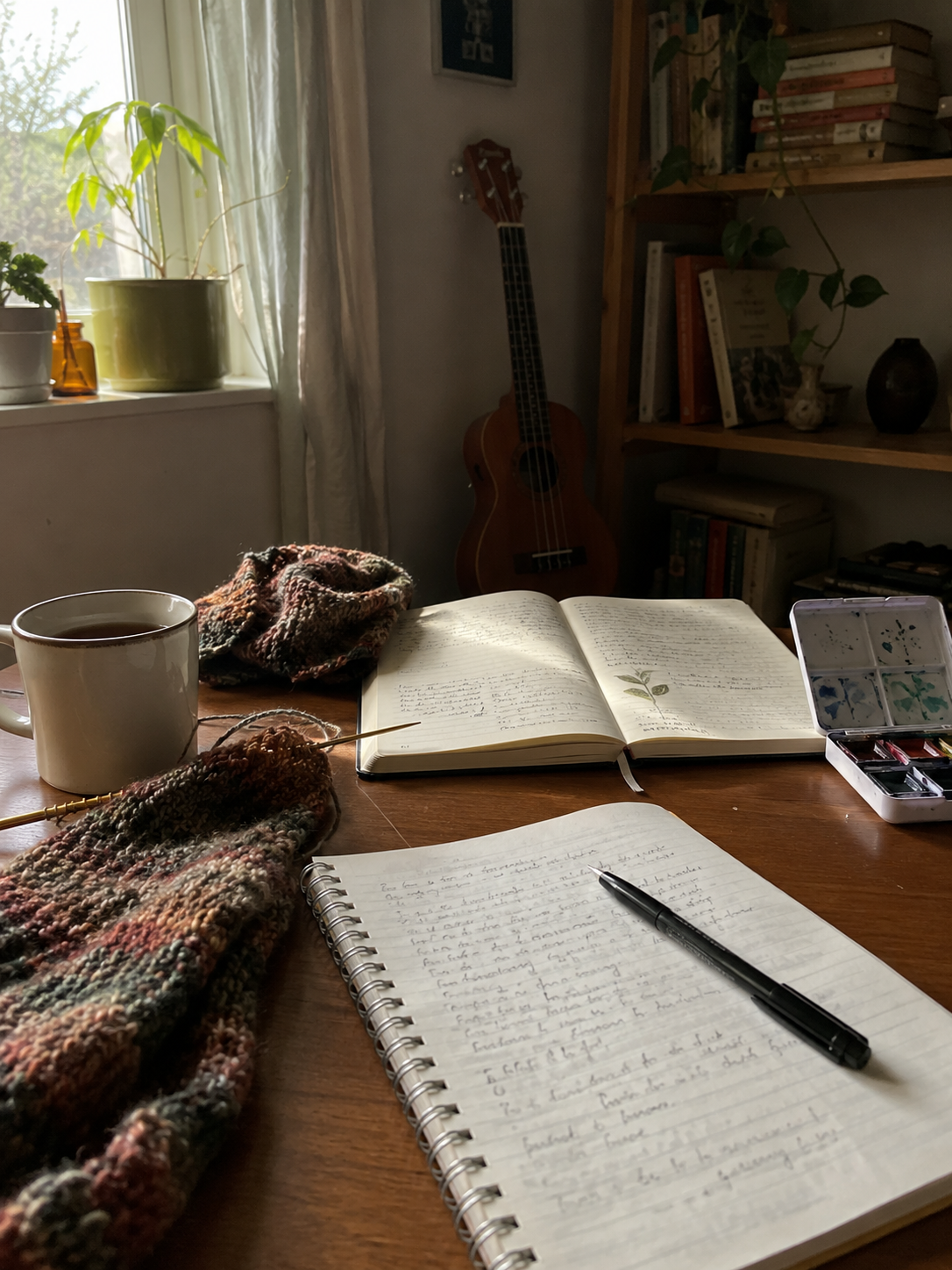
Last weekend I did something stupid and a little brave: I walked around my flat and counted everything I'd started and not finished. The half-knitted scarf. Three notebooks, each with about nine pages of a different "this is the one" idea. A ukulele I can play exactly one and a half songs on. A language app that still thinks I'm a committed beginner in two languages. A box of watercolours with two squares used. I got to nineteen before I stopped, because nineteen already felt like a verdict. For about a day I sat in the obvious story, the one everyone hands us. Flaky. Can't commit. All spark, no follow-through. I've heard it from a manager, an ex, and my own head at 2am, so I know the script by heart. And there's a grain of truth in it I'm not going to pretend away — some of those projects died because the boring middle bit arrived and I just… wandered off, the way I always do once a thing stops being new. But then I actually looked at the nineteen things, properly, instead of just feeling bad about them. And they weren't random. The notebooks were all circling the same handful of questions about how people change. The ukulele and the watercolours were both me trying to make something with my hands after a year of staring at screens. The languages were two trips I'd half-planned and still want to take. Laid out together, the "failures" were basically a map of what I actually care about, drawn in the only honest ink there is — what I reach for when nobody's making me. That reframed it for me, and I want to be careful not to make it too tidy, because it isn't. A map is not the same as arriving anywhere. You can't show people a beautiful map of nineteen places you never visited and call it a trip. The scarf is still cold and useless. But I think we mislabel the thing. We call it a commitment problem when a lot of the time it's an appetite problem — we're hungry for the entry point of almost everything, and the entry point is genuinely the most interesting part if you're wired to love beginnings. What's helped, a bit, is being ruthless about the difference between the projects that are research and the ones that are actually meant to be finished. The notebooks can stay unfinished forever; they were never going to be a book, they were me thinking. But the scarf was a gift for someone, so the scarf has a deadline now and lives by the door where it annoys me. I'm trying to stop treating every started thing as a moral debt and start asking which three actually have a person or a date at the end of them. The other sixteen are allowed to just be evidence that I'm curious and alive. I haven't solved it. I started writing this post twice and abandoned the first version, which I only noticed halfway through, which is so on-brand it's almost funny. So I'll throw it to you. When you look at your own pile of unfinished things, does it read as failure or as a map of what you love? Has anyone found a way to actually finish the few that matter without killing the part of you that needs to keep starting new things? And for the types who finish everything they begin — does an unfinished project genuinely bother you, or is that just a story we tell ourselves about you?
-
Every few weeks someone new turns up here and the first thing I want to ask is the slightly nosy question: so what are you? Not in a box-you-in way. It's just that knowing someone's four letters changes the conversation a little, in a good way, the way knowing someone's from the same hometown does. If you've never actually taken the test, or you took some random one years ago and can't remember the result, we have our own. You can run it straight through the bot here: — about ten minutes, it asks you the questions, and it hands you a type at the end. Answer as the person you actually are on a normal day, not the one you'd like to be in meetings, or you'll get a flattering result that recognises you less. Then come back and drop it in this thread. I'm honestly more interested in the misses than the hits. The bits where you read your type and thought no, that's not me at all are usually where the good conversation is. So: what did you get? Did it fit, or did it get something badly wrong? And if you've taken the test before, did your type ever change over the years, or has it stubbornly stayed the same?

-
I ran a small volunteer thing last year, badly organised, no budget, the kind of project that should have died in week two. It didn't, and for a long time I couldn't work out why. We had no proper plan, half the people had never met before, and I kept losing the spreadsheet. By every sensible measure it should have fallen apart. Then someone told me, half as a compliment and half as a complaint, that I'd talked five different people into believing they were the perfect person for jobs they'd never have volunteered for. I hadn't planned it. I'd just looked at each of them and genuinely seen the thing they were good at, and said so, out loud, probably more than once. One of them sticks with me. A quiet guy who'd signed up to "help with whatever," clearly expecting to stack chairs. Within a week he was running the whole logistics side, because I'd noticed in passing that he was the only person who actually remembered what we'd agreed in the last meeting, and I told him that made him the one person we couldn't lose. He looked genuinely surprised. Not falsely modest, surprised. Like nobody had ever framed his careful, unflashy brain as a strength before. That's the ENFP strength I never see on the strengths lists. Not the brainstorming, not the enthusiasm, though we have plenty of both and they get all the attention. It's that we tend to see people a size larger than they see themselves, and we say it out loud before we've thought about whether it's awkward. Half the time the person had no idea anyone noticed. And it isn't flattery, which is the part that matters; flattery is telling people what they want to hear, and this is closer to the opposite. It's telling people something true about themselves that they've been too close to see. I think it comes from the same place as the restlessness. We're scanning constantly, picking up on potential everywhere, and people are just the most interesting version of that. Where someone else sees a colleague who's a bit shy in meetings, we see a person who's three encouragements away from being brilliant in the room. We can't really help saying it. It's not a technique we learned; it's how the people in front of us actually look to us. The flip side is real, of course, and I'd be lying if I made this all sound like a gift. The same project had about four genuinely good ideas I never finished, because the moment they stopped being exciting and turned into ordinary work, my attention quietly wandered off to the next thing. And I burned out a bit by the end, because seeing everyone so clearly also meant absorbing all of it, every worry and bad mood, as if it were mine to carry and fix. So I'm not romanticising it. But the seeing-people thing still feels like the actual superpower, the one I'd least want to trade away. The trick, I think, is learning to do it without quietly setting yourself on fire to keep everyone else warm. I'm still working that part out. So I'm curious how it lands for the rest of you. What's the ENFP strength you'd defend even on a bad day, the one that survives the burnout and the half-finished projects? Has anyone ever named a strength in you that you hadn't noticed in yourself until they said it? And for the non-ENFPs reading along, does this read as a genuine gift, or does being seen that clearly sometimes feel like a lot?
-
What strikes me, reading something like this in the evening, is how strange it is to find yourself in a taxonomy — to be named, categorised, held still on a page — when the actual experience of being yourself feels so much more like weather than architecture. I came to this late, at forty-three, and I'm not sure I have language for what that timing does to a person.